Auto-analyze ERPs and Databases to Reveal Untapped ROI
The New Standard for Enterprise Analytics is Agentic
Lumi's agentic analytics platform connects to all your data sources, automatically builds your semantic layer, and proactively surfaces the opportunities hiding in your data.


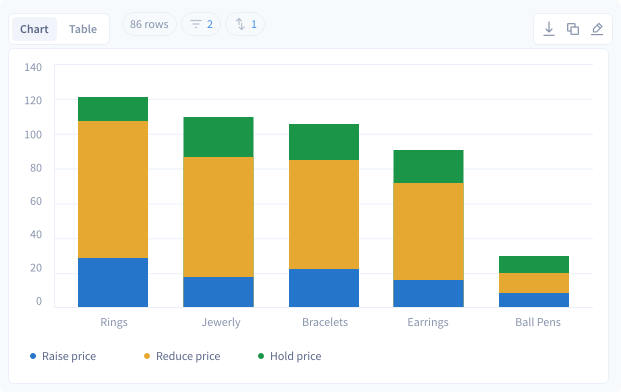
Lumi’s ability to de-average and re-aggregate down to store-item impacts makes it far more efficient.

It was obvious during the pilot that Lumi could take care of a lot of the challenges. You could just ask.
Lumi identified $60M in additional revenue by targeting customers most likely to shift to higher AOV transactions.
Lumi AI users have identified over $150M of value-driving insights with autonomous analytics workflows
Configure Lumi to hunt for opportunities around metrics that matter. Define objectives around increasing revenues, decreasing costs, or freeing up working capital, and watch the agentic workflows spring into action. Self-service analytics is the starting point. Proactive analytics is the final destination.
Kroger finds seven figures of unfulfilled demand in OvS
"Lumi's ability to de-average and reaggregate down to store-item impacts makes it far more efficient than anything we had before."
Demand Planning

Chalhoub identifies $60M opportunity to increase shopper AOV
“ We identified a cohort of prime candidates for conversion to omni-channel that were not previously visible.”
Shopper Cohort Analysis

Growmark cuts down time to insights and reporting workload
“ It was very obvious during the pilot that Lumi could take care of a lot of the challenges. You could just ask."
Price Sensitivity

"Lumi is fundamentally transforming how teams access and use data by shifting the focus from data retrieval to data-driven decision-making.
Instead of spending hours pulling, cleaning, and structuring data, business leaders and analysts can engage directly with insights through a simple conversation—getting immediate answers and iterating dynamically with follow-up questions.
By removing the friction of data preparation and enabling iterative, conversational analysis, it empowers both leaders and analysts to move faster, ask better questions, and devote more time on decisions—not data wrangling."
Casey Gerhard, Director of Data Governance & Reporting Solutions @ Levy Restaurants
Built for the security standards data leaders require
SOC 2 compliant with enterprise-grade access controls, so your team moves fast without compromising governance.

Independently audited security controls

Your data never touches other customers' environments

Enforce data permissions at the user level

Private gateways keep data within your boundary
Data & business teams both love using Lumi
Whether it’s for conversational self-service analytics at scale, agentic workflows to cut analysis time by a factor or ten, or uncovering new opportunities hidden in large operational datasets.




Ready to see what's buried in your data?
Most teams find their first seven-figure opportunity within 30 days of deployment.